

System support for chronic fatigue starts with understanding that the answer isn’t always to do more.
Sometimes we feel inclined to do more exercise, be more productive, disciplined, and push through.
But chronic fatigue rarely responds well to pressure.
A more useful question may be: what does the body need in order to function, regulate and produce energy more effectively?
From a functional perspective, fatigue can involve multiple interconnected systems. Rather than focusing solely on the symptom of fatigue, the goal is to understand and support the underlying factors that may be placing additional demands on the body.
One way of thinking about this is through the SMART paradigm.
S – Safety
Before productivity, the body needs a sense of safety.
This means considering the nervous system and the balance between demand and capacity. When the body is continually responding to perceived stress, it can become harder to prioritise processes such as digestion, repair, sleep and energy production.
M – Metabolic Support
Energy production depends on the raw materials and conditions required to make it.
This includes factors such as blood sugar regulation, mitochondrial function and adequate micronutrient availability. Supporting these foundations can help provide the body with what it needs to generate and utilise energy.
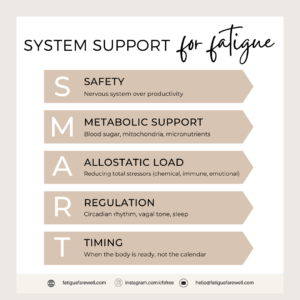
A – Allostatic Load
The body responds to the total load placed upon it.
Chemical, immune, environmental, emotional and physiological stressors can all contribute to this overall burden. Looking at the bigger picture can help identify areas where unnecessary load may be reduced.
R – Regulation
Recovery requires rhythm and regulation.
Circadian rhythm, sleep quality and autonomic balance all influence how the body transitions between periods of activity, repair and restoration. Supporting these rhythms can be an important part of creating the conditions for recovery.
T – Timing
Perhaps most importantly, timing matters.
The body doesn’t necessarily recover according to our calendar or the expectations we place upon ourselves. What is appropriate at one stage of recovery may be too much at another.
The SMART approach isn’t about finding one intervention that fixes fatigue. It’s about looking at the body as an interconnected system and gradually addressing the factors that may be preventing it from functioning optimally.
Rather than chasing the symptom, consider supporting the systems behind it.
Because sometimes the path forward isn’t about pushing harder.
It’s about creating the conditions in which the body can begin to do what it is designed to do.
You can find other ME/CFS related blogs here.

Shaun Moran