

When fatigue becomes persistent, overwhelming, or unexplained, effective fatigue solutions for chronic fatigue rarely come from a single supplement or test result.
Instead, lasting recovery usually requires a whole-body approach that reduces what drains energy while restoring what the body truly needs.
In my experience, sustainable fatigue recovery often follows four foundational principles.
Remove what the body does not need
Chronic fatigue usually manifests and lingers when the body is under constant load. Such factors may include chronic infections, mould exposure, inflammatory foods, environmental toxins, or unrelenting physiological and emotional stress. These factors adversely impact mitochondrial function and result in the immune and nervous systems remaining in a state of defence.
Lowering this burden, through a combination of tackling hidden infections, improving air and food and water quality, reducing toxic load to lowering daily stressors each create the conditions the body needs to begin healing.
Restore the body with what it does need
Once the load is reduced, the body can better synthesize and utilise the fundamentals it relies on to produce energy. This includes adequate nutrition, targeted supplementation, cellular hydration, deep sleep, and mitochondrial support where required.
Restoration is not necessarily about doing more, but about giving the body the right inputs at the right time, in a way it can tolerate.
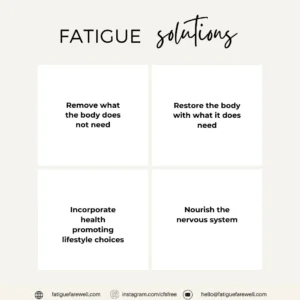
Incorporate health-promoting lifestyle choices
Lifestyle interventions cannot be underestimated when it comes to addressing fatigue. Gentle movement, pacing, sunlight exposure, and consistent daily rhythms all play an important role in fatigue recovery. Rather than pushing through exhaustion, learning when to rest and when to move supports long-term progress.
Small, sustainable habits often outperform aggressive routines.
Nourish the nervous system
The nervous system is key to energy regulation. Past trauma, ongoing stress, or prolonged illness can keep it stuck in survival mode, hampering recovery.
Practices that promote safety and regulation, such as breathwork, trauma therapies, rest, community, and nervous system support all help shift the body toward repair.
When these four foundations are addressed together, fatigue no longer needs to be fought.
Instead, the body is supported in doing what it’s designed to do: recover, adapt, and restore energy over time.
You can find other ME/CFS related blogs here.

Shaun Moran